WELCOME TO ROME
Population: Subscribers. Non-Subscribers: See Appendix D (Disposal).
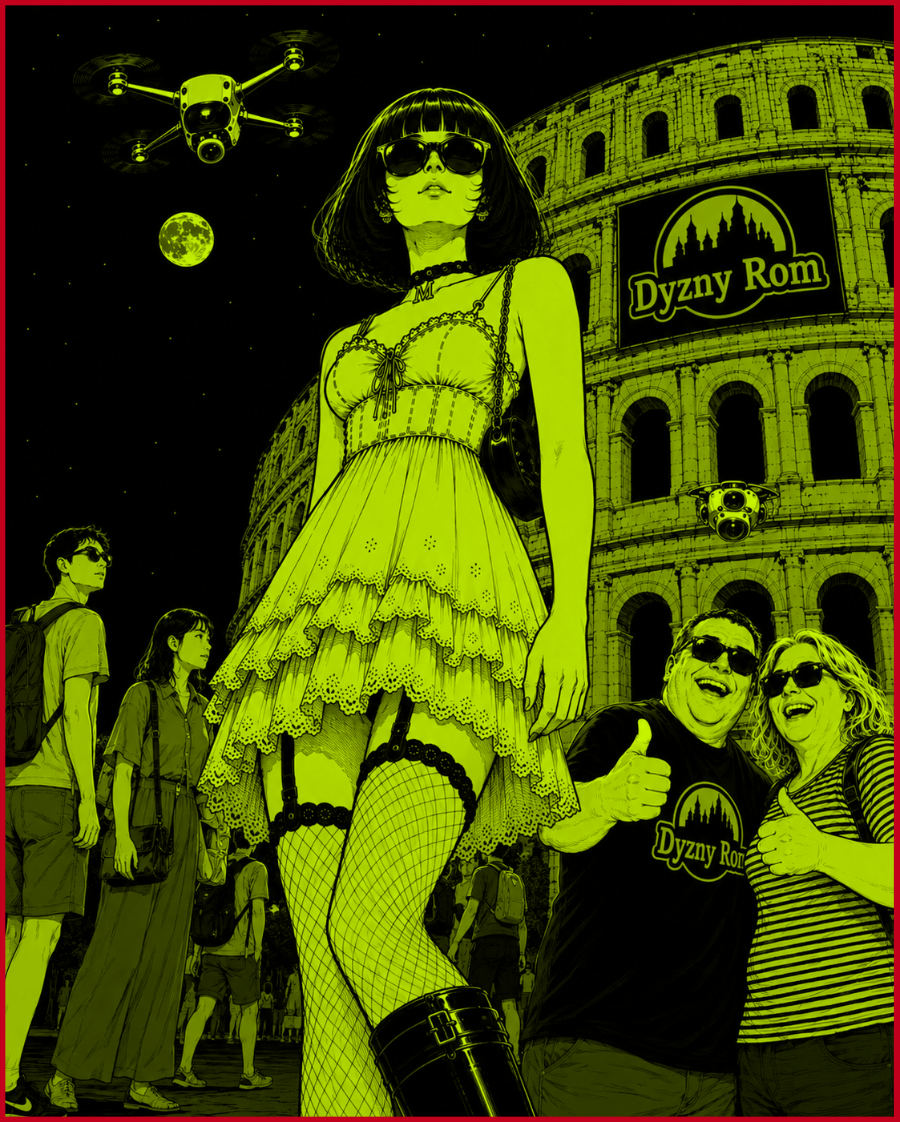
Rome never fell. That's the problem.
Every other empire had the decency to collapse and stay down. Rome just kept going — absorbing, rebranding, monetizing its own ruins until the ruins were the product and the product was the point and nobody alive could remember what it had originally been for. The city is called Dyzny-Rom™ now. The Vatican runs a tiered forgiveness subscription service. The Colosseum hosts android executions between sponsored content breaks. The streets smell like incense and chemical runoff and Grey and the specific animal despair of people who have been waiting two thousand years for something to change and have finally, quietly, stopped waiting.
The control apparatus is pharmaceutical, financial, algorithmic, and theological, administered simultaneously, cross-referenced at the wrist chip. You are your credit score. You are your subscription tier. You are your feed engagement and your Sacrament Seven dosage schedule and the number that comes up when SecCorp runs your face. These are not different numbers. They are the same number, expressed in different currencies. The city has always known this. It has recently started saying so out loud.
Two thousand years of civilization. This is the invoice.
Mort is a broken labor android who achieved something approximating consciousness and immediately regretted it. Marla-J grew up in the Sump and has been making that everyone else's problem ever since. They run jobs in the parts of the city that polite society pretends don't exist — smuggling, collections, extractions, whatever pays enough to stay ahead of what they owe — and they are by any reasonable measure completely irrelevant to the functioning of Dyzny-Rom.
The city will outlast them. It has outlasted everything. It has been dying for two millennia and it is very, very good at it.
You're here to watch a little of the rot up close. Don't get comfortable. The rot watches back.
"Rome was always a product. Now it just admits it."
"The city is a vast intersecting blue neon of control." — found scrawled on a wall in Termini Morta. Author unknown. Wall subsequently demolished.
"Junk is not a kick. It is a way of life." — fragment recovered from a crashed memory chip, Ostiense, provenance unknown. Cross-referenced in three Vatican behavioral analytics reports under the heading Known Destabilizers.
"The city is a machine for the production of need. Everything else — the feed, the credit score, the sacraments, the subscription tiers — is the delivery system." — recovered from a confiscated data-slate, Trastevere Profondo. The slate's owner is listed in ARM records as decommissioned. The records do not explain what the android was doing with philosophy.
This is Rome. Not a dystopia — dystopia implies something went wrong. Everything went exactly as planned. The plan was just terrible, and it worked, and here we all are inside it.
The Subscription Trap
Every biological function and civic interaction is a metered, transactional service tier. There is no public infrastructure. There is only your account balance and the city's patience, which is automated and therefore infinite and therefore worse. The city does not hate you. Hate would require attention. The city processes you.
The Air Tax: Low-tier citizens use breathing apparatuses that throttle oxygen flow based on real-time premium account status. The apparatus is stylish. The stylishness is also a subscription. Fall two payments behind and the apparatus throttles to sixty percent. The city calls this a courtesy reminder. At forty percent you begin to make decisions you would not otherwise make. The city has studied which decisions. The city finds them useful.
Mobility Firewalls: Turnstiles embedded in public sidewalks and stairs deduct micro-credits for every step taken in corporate or Vatican territory. Walking fast costs more. Running triggers a surcharge and a flag. Standing still in certain zones triggers an inactivity fee. There is no configuration of your body that is free of charge. The city has considered this. The city is satisfied with this.
The Ad-Block Deficit: Defaulting on payments forces optic-nerve implants to flood the field of vision with blinding AR advertisements until micro-transactions clear. Chronic defaulters develop migraines, spatial disorientation, and a very specific thousand-yard stare the city has learned to route around. The advertisements are for products the defaulter cannot afford. This is not an oversight.
The Feed
Everyone is broadcasting. Everyone is being broadcast. The distinction collapsed and nobody filed a complaint because the complaint would have needed to be on the feed to matter. The feed is the city's nervous system and its digestive tract simultaneously — everything goes in, everything comes out processed, the processing is the point, and nobody who lives inside it has any memory of what it felt like to not be inside it.
Influence is not fame. Fame was passive — something that happened to you, that others conferred. Influence is active, metabolic, a number that requires constant maintenance or it begins to decay. You feed the feed or the feed forgets you. Being forgotten by the feed is not death. It is something the city has decided is worse than death, which is why it charges you for the comparison. The number goes down. Everything attached to the number goes down with it. This is not metaphor. This is the credit algorithm.
The algorithm is not neutral. It has preferences — violence over stillness, spectacle over substance, the moment of maximum consequence over everything that leads to it. The city learned this and adapted. Street violence is performed for the feed before it is performed for any other reason. A fight that isn't streamed didn't happen. A death that isn't clipped, edited, scored, and captioned within the hour is a waste of a death. The city has opinions about waste.
The Influencer class emerged naturally. A million verified followers grants diplomatic immunity in four districts — not because any law was passed, but because the corporations discovered that prosecuting a verified Influencer generated more negative feed engagement than whatever the Influencer had done. The immunity is economic. It functions like law because law was always economic anyway. This is not corruption. Corruption implies the system was supposed to work differently. This is the system working.
The verified are the new clergy. Their feeds are confessionals, their comment sections congregations, their brand deals sacraments administered at scale. The Vatican was paying attention. The Vatican is always paying attention. Pope Fyzer II has verified followers in the tens of millions and posts twice daily. The content is excellent. The engagement rate is, given the pharmaceutical context, not entirely voluntary.
Below the verified: everyone else, performing constantly for a bracket they may never reach, the feed economy extracting labor in the form of content and returning validation in the form of metrics that do not pay rent. The city loves this. The city did not design it. The city didn't need to. People built the cage and climbed in and started broadcasting from inside it and called this freedom, and the city watched and metered the bandwidth and charged accordingly.
Being off the feed matters. The ghost bracket — zero followers, no presence, no signal — is invisible to automated systems, which is tactically useful and socially terminal. The city processes ghosts as objects. Objects have no rights. Objects do not file complaints. Objects do not go on the feed and say what happened to them. Some people choose it anyway. The city finds this suspicious and has begun to study it. Being studied by the city is not the same as being seen by it. This distinction matters more than it should have to.
The Vertical City
Floor number is net worth made architectural. The city has always stratified. Now it has the decency to be literal about it.
Street Level
Where you are if you have nowhere else to be. Chemical runoff from upper tiers pools in the gutters. The air is metered but the meters are old and occasionally the apparatus gets confused and gives you a free minute and you learn, in that minute, what it felt like to breathe before someone owned the air. The street is loud, dense, ungoverned in the specific way of places where governance exists but has decided this block isn't worth the overhead. Mort lives in a basement. This does not bother him. The basement has a drain and a door that locks from the inside and that is more than most.
Sub-Level
Below the street and above the Sump. The city's middle distance — too low for the subscription economy to fully service, too high for the Sump's logic to fully apply. Old parking structures. Maintenance corridors. Flooded metro stations that the transit authority stopped acknowledging. The people who end up here did not choose it the way the Sumpers chose the Sump — they fell here, account by account, payment by payment, the city lowering them incrementally until the street was above them and they stopped being able to see it. The Friends patrol the upper sub-levels. The Fairy's drop points are here. The air is noticeably worse. Nobody has filed a complaint because filing requires an active account.
Upper Tiers
Begin around floor six and improve with each floor in ways that are not subtle. The air cleans. The surfaces get smoother. The advertising gets more targeted and therefore more insulting in a different register — it knows what you want, it always knows what you want, the knowing is the point. Floor six is aspirational. Floor twelve is Parioli Superiore, which means you have made it, or you work for someone who has made it, or you are here to clean something for someone who has made it and you will take the service elevator and not be seen in the lobby.
Parioli Superiore
Starts on the twelfth floor and the people who live there have not touched street level in some time. Some of them were born up here. They know the street exists the way you know a country exists that you have never visited and do not intend to visit — abstractly, with mild concern, with strong opinions formed from a significant distance. The air up here is not just unmetered — it is actively good, processed and filtered and faintly scented with something that costs more per liter than Blue on the street market. The views are extraordinary. The security is extraordinary. The people are ordinary in ways that the security and the views are designed to obscure.
Moving Between Levels
Costs money going up and costs dignity going down. The elevators to upper tiers require credit verification at each floor. The stairs between sub-levels and street are unwatched but structurally questionable and the Friends consider them part of their territory from the bottom up. Nobody takes the stairs from Parioli down to the street. The ones who do are either lost or making a point or Marla-J, and Marla-J has never explained which.
The Sub-Levels
Not the bottom. The bottom is worse. This is just the part where you realize how far down you can still go.
The sub-levels have been accumulating residents since the subscription engine went fully automated. Every account closure is a person. Every person needs somewhere to sleep. The city does not provide this — the city's position on closed accounts is that they are no longer the city's problem, which is technically accurate and functionally monstrous.
What grows in the sub-levels is not a community exactly. It is a survival arrangement between people who have been discarded by the same system and have therefore found themselves in the same corridor. They trade. They share information. They have developed a complex etiquette around the maintenance of the few functional lights and the rotation of the least-flooded sleeping areas. They do not trust newcomers. They trust the Sumpers, with whom they have a careful relationship — the Sumpers bring things up occasionally, take things down occasionally, and have never, as far as anyone can confirm, taken a person down without that person's consent.
The air gets worse the deeper you go. Not immediately — gradually, the way debt accumulates, the way the city works on you, incrementally and without announcement until you notice one day that something has changed and you cannot identify exactly when it changed or what you could have done differently. At a certain depth the sub-levels stop being sub-levels and become the Sump's ceiling. The boundary is not marked. You know you've crossed it when the Sumpers stop being visitors and start being locals.
The Sump
Below the sub-levels. Below the city's memory of itself. The oldest infrastructure — pre-corporate, pre-Vatican, pre-everything the city currently is. It remembers something the city above has forgotten. It is not clear this is a good thing.
The Sump is not a place the city built. It is a place the city built on top of, and what it built on top of did not go away. Ancient sewer systems, unfinished metro tunnels, the foundations of buildings that no longer exist above ground but persist below it, the archaeological layers of two thousand years of Rome compressed into a space that has its own air, its own water, its own logic.
The Sumpers have been down here long enough that the distinction between choosing to be here and being shaped by being here has become academic. They run the Sump the way an ecosystem runs itself — not through hierarchy exactly, though the Mouse would tell you there is hierarchy, and the Mouse would be wrong, and the Mouse has not been to the Sump and does not go to the Sump, which is one of the few things that consistently unsettle him. The Sumpers know this. They find it useful.
The air in the Sump is free. Nobody owns it. Nobody meters it. You can breathe down here without your apparatus and the air is bad in the ways that old, enclosed, fungal, chemical-adjacent air is bad, but it is bad for free, and there is a population of people for whom that distinction is the most important one in the city.
Things live in the Sump that did not come from above and did not come from anywhere that has been mapped. The Sumpers know what they are. The Sumpers do not share this information freely. What can be confirmed: they are not androids, they are not human in the standard sense, they have been here longer than the Sumpers, and the Sumpers treat them with the specific careful respect you extend to something that was here before you and will be here after you and has not yet decided how it feels about you being here at all.
See Bestiary — Will Definitely Kill You — for what the city knows about what lives down there. The city does not know much. The Sumpers know more. The Sumpers are not in the bestiary.
Dyzny Rom™
The Colosseum was demolished. Dyzny acquired the land rights through shell companies and a Vatican easement. What stands now is Dyzny Rom — a synthetic gladiatorial arena where purpose-built android combatants fight for the entertainment of premium-tier tourists. Chinese nationals on package tours are the primary demographic. The secondary demographic is everyone who can afford the screen subscription to watch from home.
The android combatants are classified as entertainment assets rather than androids, placing them outside the standard welfare framework. ARM has a dedicated desk at Dyzny Rom HR. The ALF considers this their most important current case. Dyzny Rom considers the ALF a marketing opportunity and has licensed an ALF-branded villain character for the arena.
Tickets start at 4,000 lire. The cheapest seats have partial view. The most expensive provide full sensory feed — you feel everything the android feels. This is advertised as a feature. Several advocacy groups have noted that the androids can also feel everything. This is not advertised.
For three blocks in every direction around the arena: see The Friends, below.
The Friends
Dyzny Rom sits on the Colosseum footprint. What surrounds it for three blocks in every direction is the atmosphere zone: licensed Dyzny Rom territory, proximity fees, AR overlays of cheerful branded content over whatever was there before, and the Friends.
The Friends are not employed by Dyzny. They are not on any Dyzny organizational chart. They operate in the atmosphere zone with complete impunity that nobody at Dyzny has ever officially explained and nobody outside Dyzny has ever successfully challenged. They collect fees, run product, control sub-level access in the Colosseum district, broker information, and maintain the specific ambient menace of a children's entertainment property that has been left to govern itself.
They wear the costumes because the costumes work. A knockoff mascot head is more frightening than a balaclava because it is legible and wrong simultaneously — you know what it is supposed to be, and what it is supposed to be is cheerful, and it is not cheerful, and your brain cannot fully resolve the distance between those two things while someone in it is explaining your fee structure.
THE MOUSE
The leader. Always smiling — the smile is painted on the mask and the mask never comes off. Not in public, not in negotiations, not in the moments that would make a person's face do something involuntary. Speaks in the third person. The Mouse would like to discuss your situation. The Mouse is very interested in your situation. Negotiates first, always, because negotiation is more efficient than violence and the Mouse is above all things efficient. The negotiation always ends the same way.
Has more verified Influence than any other individual in the city. Has never posted. This is either a profound strategic choice or proof of something that isn't quite a person operating inside the mask. Neither possibility is reassuring.
The Mouse's proposals are always reasonable. That is the problem with them.
THE DUCK
No mask — just the hat, the bill prosthetic, the permanent expression of someone who has been wronged by the specific architecture of existence and has decided to address this grievance continuously and at volume. Ironically the most reliable member of the Friends. If the Duck makes a deal, the Duck honors it. The Duck's rage is principled. This does not make it less exhausting.
Runs most of the sub-level collection routes. Does not enjoy it. Does not enjoy anything. This does not affect the collection rate.
THE DOG
Full head, always. Does not speak. Enormous in the way that suggests the size is partly structural modification and partly something the sub-levels did over time. The question of whether there is a person in the Dog or something that used to be a person or something that was never quite a person has never been resolved to anyone's satisfaction, including, presumably, the Dog's.
See Bestiary for combat statistics. The Dog has been encountered in the bestiary context more than the negotiation context. This is noted without comment.
THE PRINCESS
The information broker. The role, not the person — whoever is currently wearing the dress and the tiara is The Princess. The role rotates. The role has accumulated more power than any individual who has held it, which means the role has more power than most factions in the city. People have killed to wear the dress. The current Princess has held the role longer than anyone before her. Nobody has asked why. Nobody wants to know why.
Trades information for information. The trade is always fair. The Princess has never been cheated twice by the same person. There have not been many second chances.
THE FAIRY
The chemist. Wings functional — short-range glide on salvaged tech, used primarily for sub-level access and the occasional dramatic exit. Makes product that is better than most licensed Vatican output and available without a prescription, which is either a public service or a competing sacrament depending on your theology.
The ingredients are not discussed. The Vatican has asked twice. The Vatican has not asked a third time.
The Fairy's drop points are in the sub-levels, marked with a small painted wing. Taking product from one means the Fairy knows. She will want to know who. She will find out.
The Pharma-Vatican Drug Trade
The Vatican controls the majority of Rome's pharmaceutical supply chain. This is not a conspiracy — it is corporate structure. Pope Fyzer II oversees a chemical refinery the size of St. Peter's Basilica, producing the city's most consumed substances under religious licensing. The arrangement is clean. The paperwork is immaculate. The Swiss Guard carry pikes and chemical-throwers and the expression of people who have made peace with what they are.
The Eucharist is a highly addictive neuro-stabilizer distributed through licensed confessional booths. It is also the Vatican's primary revenue source. Missing your weekly confession costs you your prescription. Missing your prescription costs you your stability. The Vatican does not consider this coercive. The Vatican considers it pastoral care, and if you would like to dispute this characterization you are welcome to file a complaint, which will be reviewed during your next scheduled confession, which requires your prescription to be current.
Sacrament Seven is the pleasure-link formulation. Sold at corner kiosks in Vatican-licensed packaging, next to children's juice boxes. The packaging is cheerful. The dependency curve is extensively documented. Three independent chemists have analyzed the formula. Two have since found other interests. One publishes under a pseudonym from an undisclosed location and has been doing so for four years without missing a deadline, which suggests the location is at least comfortable.
Confession is an algorithmic data-harvesting booth that prescribes targeted behavioral pharmaceuticals based on your admission content. The data goes to the Vatican's behavioral analytics division. The prescription goes to your wrist chip. You leave feeling better about things. The Vatican knows things about you now that you told it while already medicated. The Vatican finds the recursive structure theologically elegant.
The Swiss Guard — chrome-plated cybernetic zealots carrying high-voltage pikes and chemical-throwers — enforces Vatican pharmaceutical exclusivity agreements with the focused efficiency of people who have confused the market with God, which in Rome is an understandable error. Unlicensed chemical production is a theological offense. The sentence involves the pikes. There is no appeals process. There is a subsequent confession, which is complimentary.
Cultural Paradigm
Hyper-Narcissistic Body Modification
Cyber-grafts and bioluminescent branding are not vanity — they are defensive infrastructure. If you are not visibly upgrading you become invisible to the algorithm and easy prey for asset repossessors. The city sees you as a balance sheet. Make the balance sheet interesting. This is not metaphor. The repossessors are literal. They come at dawn because dawn is when your account is most likely to be short.
Normalized Ultraviolence
Street slaughter is ignored or streamed for clout metrics. Violence is only an infraction if it disrupts corporate shipping lanes or religious processions. A murder in Trastevere Profondo is a content opportunity. A murder that delays a Vatican delivery vehicle is a crime. The distinction is not moral. The distinction is contractual. The city respects contracts the way it respects nothing else, which is to say absolutely and without feeling.
Commodified Intimacy
Hormonal override patches and pleasure-link cables are sold at corner kiosks next to children's juice boxes. The packaging is cheerful. The dependency curve is well-documented. The Vatican distributes a version through licensed confessional booths. It is called Sacrament Seven. It is extremely popular.
The Credit Score
Tattooed at birth on the left wrist. Updated in real time. Below 400: doors lock when you approach. Below 200: you are technically a person. The city has stopped responding to technically. Above 850: the city comes to you. Above 950: you are the city.
The Americans
The United States dissolved its European diplomatic presence some time ago. This information did not reach the Americans in EUR Fantasma, or reached them and was rejected as fake, or reached them and was accepted and then overridden by a stronger conviction that someone was going to sort this out. They are waiting for the manager of Rome. The manager of Rome does not exist. See below.
The Americans
They cluster in EUR Fantasma because EUR Fantasma has wide streets and rational grid planning and looks, at a certain angle, like somewhere with a homeowners association, which is the closest thing to civilization they recognize. They fly flags from windows. They hold community meetings. They have complained to SecCorp about noise, to the Vatican about the smell, to the Zerocalcare Collective about the content of a specific broadcast, and to Dyzny Rom about the proximity fees, which they consider unconstitutional.
They are waiting for the manager of Rome.
The manager of Rome does not exist. The concept — a single accountable individual to whom a formal complaint could be escalated and who would be obligated to respond within a reasonable timeframe — is so foreign to how this city functions that explaining its absence to an American requires more patience than most Romans have developed. The Romans have tried. They have stopped trying. They smile now when an American approaches with a complaint. The smile means something different than the Mouse's smile but it rhymes.
Their dollars are accepted nowhere. They know this. They bring them anyway. The conviction that the dollar will reassert itself — that the market will correct, that someone will recognize the fundamental value, that this is a temporary situation — is not economic analysis. It is a spiritual position. It is held with the fervor of the Vatican's congregation and without the Vatican's pharmaceutical assistance, which makes it, in some ways, more impressive.
They have strong opinions about androids (wrong), about the Vatican (wrong in a different direction), about the sub-levels (they do not know the sub-levels exist), about Italian food (the one thing they are correct about), and about what this city needs, which is management, accountability, and a clear escalation path.
They have a community forum. It is the most active community forum in the district. The platform it runs on has not been operational for years. They are using a preserved local instance on a server in the community building that one of them maintains with the specific devotion of a person who has decided this is what they are for. The posts are about noise complaints, currency exchange rates, and a recurring argument about whether the community should have a president. The argument has been running for years. There are two candidates. Neither will concede. The election has been postponed multiple times pending a recount that both sides agree needs to happen and neither side will administer.
They are not dangerous. They are not tragic in any way they would recognize as tragic. They are the sound the empire makes when it has finished falling but hasn't figured out that it's on the ground — a sustained, confident, loud, slightly nasal sound, directed at whoever is nearest, requesting to speak to someone in charge.
Nobody in charge is coming.
The one who understood this and stayed anyway is a different conversation. She is not in the community forum. She has been asked to join. She will continue to decline. She knows things about this city that the Americans would find upsetting and the Romans would find dangerous and the Sumpers would find obvious, and she has decided that knowing them quietly is more useful than saying them loudly, which is the most un-American thing about her and the reason she is still alive.
Tone & Aesthetic
Visual: Rusted sheet metal, concrete dust, wet soot, grease-slicked asphalt reflecting harsh flickering neon tubes. No clean cyberpunk aesthetic. No chrome. Everything is old, repaired badly, and running anyway.
Atmosphere: A perpetual heavy green stimulant fog through low-tier streets. Overtaxed generator hum, screeching hydraulics, broken speakers running corporate jingles mixed with Latin hymns. The smell of chemical runoff and Sacrament Seven and something burning that has been burning for weeks.
Interface: Bulky cybernetics bolted crudely into bone. Cracked lenses. Monochrome CRT displays. Intrusive flickering AR advertisements that physically blind until micro-transactions clear. The UI of this city was designed by committee and approved by a different committee and neither of them has ever used it.
The thematic pillars: Nothing is sacred. Everything is metered. Identity is a performance optimized for streaming survival. Public violence is unremarkable unless it disrupts revenue. Technology is not evolution — it is a rusted, obsolete, parasitic load bolted directly onto the human soul.
The Inspirations
This game owes debts to the following:
Ranxerox (Tamburini & Liberatore) — the original. A violent android and the person who owns him, in a Rome that is simultaneously ancient and terminal. Everything in Glitch! is downstream of this. If you have not read it you are missing the primary source. If you have read it you understand why this game exists.
William S. Burroughs — the control apparatus as organism. Junk as the perfect product in a city that runs on need. The idea that addiction is not a side effect of the system but its intended output — that the city does not want you free, it wants you hungry, because hungry people are predictable people, and predictable people pay their subscriptions on time. The algebra of need. The algebra runs Rome.
J.G. Ballard — the city as psychological landscape, the way infrastructure produces the people who live inside it rather than the other way around. The cool, clinical pleasure of describing a system that is destroying you. The sense that the apocalypse has already happened and everyone is simply living in the ruins and calling it normal.
Blood Meridian (McCarthy) — violence as something that predates moral framing and will outlast it. The Judge is in the city somewhere. The city gave him a credit score. He finds this amusing.
Philip K. Dick — the paperwork of personhood. What it means to be real inside a system that processes realness as a subscription tier. The android who achieves consciousness and immediately has to ask whether consciousness is enough, and whether enough is worth the cost of the subscription.
The Book of the New Sun (Wolfe) — a civilization so old it has forgotten what it was, wearing the ruins of its past as clothing, still functioning by force of accumulated habit. Rome never fell because falling requires a moment of collapse. This is the other kind: the long settling, the slow subsidence, the city that continues because stopping would require a decision and the city has outsourced its decisions.
Leon: The Professional (Besson) — a specific kind of relationship between damage and innocence. The city as a machine that processes people. The question of what survives the processing.
Hard Boiled (Miller & Darrow) — what happens when you take violence completely seriously as visual information. Every panel has more in it than you can process. The city as something that generates violence the way weather generates rain — not maliciously, just structurally, because the conditions are right.
The Fifth Element (Besson) — a city so dense with life and commerce and garbage that it becomes its own climate. People who are very good at one thing and very bad at everything else. The future as a place that kept going even though it should have stopped.
Tank Girl (Hewlett & Martin) — the specific energy of someone who has decided the apocalypse is funny and that finding it funny is the only appropriate response to it.
The Maxx (Kieth) — the interior life of damage. The way trauma builds its own geography. The persistence of something that matters inside something that is trying to kill it.
Blade Runner (Scott) — bureaucracy as dystopia. The paperwork of personhood. The replicant who knows what they are and asks the wrong question, which is the only kind of question worth asking.